
Side Quest Below the Rim
By: Katy Willcox
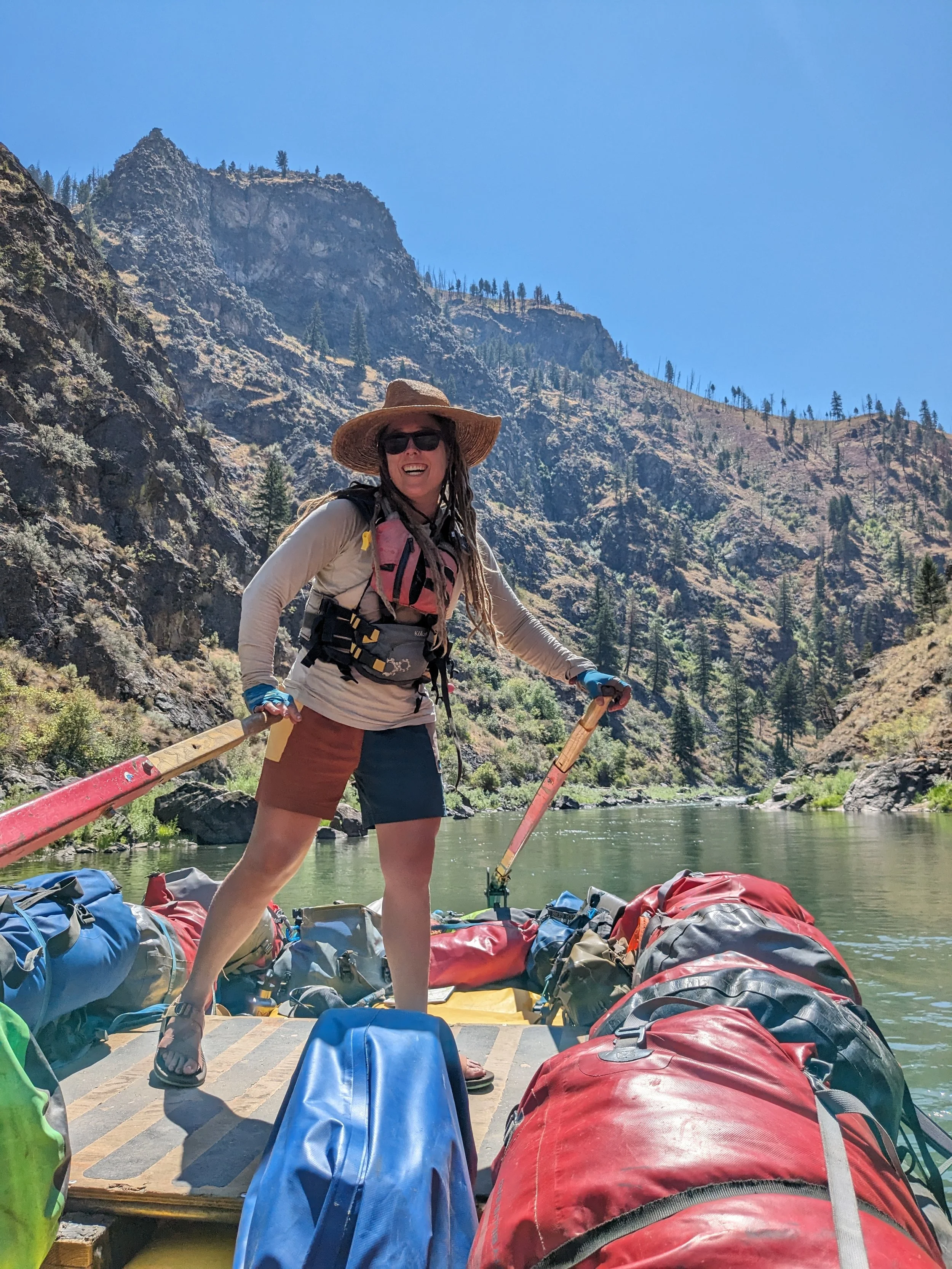
I'm Katy! I've spent 10 years as a professional river guide, outdoor educator, and ski patroller. While my life is currently taking my career on a different trajectory, adventuring and exploring the wild places of our world will always remain my passion. I strive to normalize misadventures, and to find the adventure in the everyday.
In my (elusive) free time, I am a whitewater kayaker, runner, watercolor painter, sourdough baker, campfire guitarist, eater of cheeses, giggler, knitter, and explorer of whatever art medium has currently taken my fancy (right now it's...spraypaint?).
See you on the river! - Katy
“I think we have to turn back.”
Tyler pauses, looks up at the ever-distant horizon. We’ve tucked ourselves into the last scrap of shade for what feels like miles, somewhere up in the Supai sandstone, under the merciless July sun of the Grand Canyon. His dark hair and suntanned face are slick with sweat. Behind me, Sam and Dena, our fellow adventurers, tuck into the same alcove. Sam is red-faced, his usually chipper affect subdued. Dena alone seems unfazed by the heat, chatty and cheerful despite having run out of water over a mile ago. I know I can’t possibly look any better than Sam or Tyler—I can feel the heat starting to rise in my face, and I’ve been jealously guarding the last half liter of my water. Sam ran out of water first, then Dena. Tyler has a few sips left. The last pool we passed is at least two miles back, over rugged terrain.
Tyler half shrugs, half nods, his face mostly inscrutable behind his sunglasses. “Your call,” he says.
I sigh. I hate making decisions at the best of times, especially ones that involve pulling the plug. We’ve been searching for a gallery of pictographs, splashed somewhere across the Supai, supposedly more transcendent than any other group of pictographs. Instead of small, ochre-colored figures, this gallery displays life size paintings, splashed with ghostly blues and greens. Knowing that this might be my last Grand Canyon trip for a while, I had wheedled and charmed some of my trip mates into accompanying me on this 16-mile vision quest into the desert. I feel a rising sense of disappointment, of failure. But I have to look at the hard facts: we’re out at noon, in July, in the Grand Canyon—stupid at the best of times—two of us are completely out of water, and the nearest water is at least two, if not three, miles behind us. We have rough terrain to cover on the way back, just to get to said water. We’ve looked high and low for these pictographs, but they’ve remained elusive.
I nod, trying to be more graceful than I feel. “Let’s turn back.”
Some years previous, I had heard of this pictograph panel from a co-worker on a Grand Canyon trip. He recounted accidentally finding it as he wandered up a side canyon. Instantly, I was intrigued—life-size paintings? Blue and green? It seemed like an excellent adventure. But, he warned, “It’s way the hell up there.”
The thing about being a guide is that in reality, you have very little time to truly explore the place you’re working—there are too many other demands on your time and attention, and a 16-mile side quest is generally out of the question. There’s a lifetime of exploring to be done in the Grand Canyon, and truly, I haven’t been on a bad hike there (though of course, some are better than others).
So, when I ended up with three weeks off in the middle of a busy guiding season, and a friend invited me on a private Grand Canyon trip—that somehow, miraculously, slotted perfectly into the time I had off—I knew this might be my best shot for a while to explore, and maybe, just maybe, to find this pictograph panel.
The trip unfolded with all the usual trappings of a Grand Canyon expedition—the orderly chaos at Lee’s Ferry, people experiencing huge whitewater for the first time, the exquisite heat of July, group dynamics both delightful and challenging, and of course, many, many cases of beer. I had rather early on (by which I mean first night on the river, at Sheerwall camp) established myself as a bit of a sand-bagger in my quest to explore more. I offered up a hike, blithely mentioning that it involved some exposure. In my mind, it meant fall exposure—the route involves some bouldering moves up a narrow chimney in the Supai, and then scrambling across some very sheer boulder and scree fields. Nothing a group of young, relatively fit folks couldn’t handle. Safe to say, most people weren’t quite ready for that—having both sun and bat exposure in mind—and after some good-natured ribbing, I sheepishly admitted that I maybe needed to rethink my classification scale.
So it wasn’t terribly surprising when, after days basking in the sun, soaking up the glory of the Grand Canyon, running big whitewater, and continuing to sandbag people on hikes, I was met with no small amount of skepticism when I announced that I wanted to see these pictographs. It was the latter half of our trip, and everyone was physically tired; I had finagled our schedule to include a layover at the camp we would need to do this side quest. Most people were looking forward to a day of drinking beer, lounging in the shade, and swimming in the river, maybe casually strolling up the side canyon to the first chockstone. Going on a hike of unknown distance and difficulty was, shall we say, not a priority.
I looked around the circle of my friends, some old, some new, all wearing ridiculous costumes (in the spirit of a layover day, we were celebrating a bit early), trying to explain how important this felt to me without actually pleading. I didn’t want to do it alone. Tyler was one of the few people just as interested in stupid side quests as I was, but he had expressed reluctance over this particular venture. He contemplated me over his beer.
“Is this a call to adventure?”
I nodded, solemn. He chugged the last of his beer, crushed the can, sighed, but then looked up at me with a grin. “Then let’s do this!”
We set off the next morning just as the shadows in the canyon were beginning to lighten; our friends Edith and Maria had gotten up to make sure we had coffee and breakfast, and to see us off. I felt touched by the gesture—after all, they could have slept in. Edith shook her head, smiling. “It’s cool that you’re doing this. We just wanted to make sure you got out all right.”
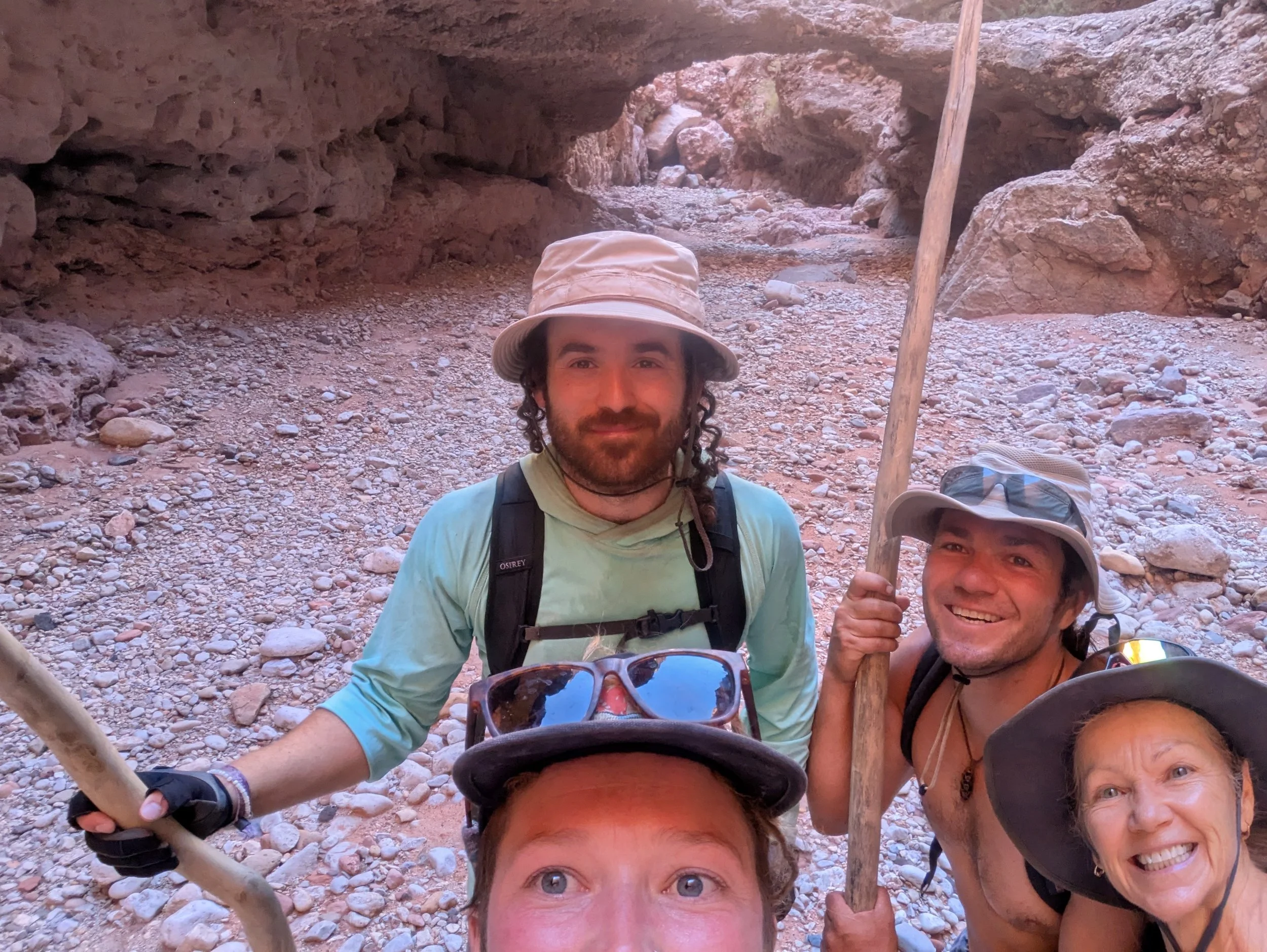
Surprisingly, our friend Sam and Tyler’s mom, Dena, join us—ostensibly just for the first few miles. Sam is a software engineer in Silicon Valley, and this trip is his first big outdoor adventure, but he’s proven his mettle when it comes to scrambling, exposure and generally slightly stupid side hikes. Dena joined us at Phantom Ranch, and has the stamina and heat tolerance of someone thirty years younger. She and Tyler bicker good-naturedly as we set off up the side canyon.
At first, in the cool morning air, we cheerfully liken ourselves to the Fellowship of the Ring—quoting the movies at each other and singing the musical themes of Lord of the Rings. We come to the first chockstone, then the second, then the third. I wouldn’t say we scrambled over them with ease, but we figured them out and got everyone up safely. “It’s like a boss battle!” Sam exclaims eagerly. “Like in video games!”
We all laugh, but after that, we do start calling the chockstones the “bosses.”
“Oh, we’ll have to make it down past that fifth boss!”
“Forget about the fifth, the third boss was harder!”
“Those are going to be fun on the way back down,” Tyler laughs, waggling his eyebrows at me. I laugh in agreement.
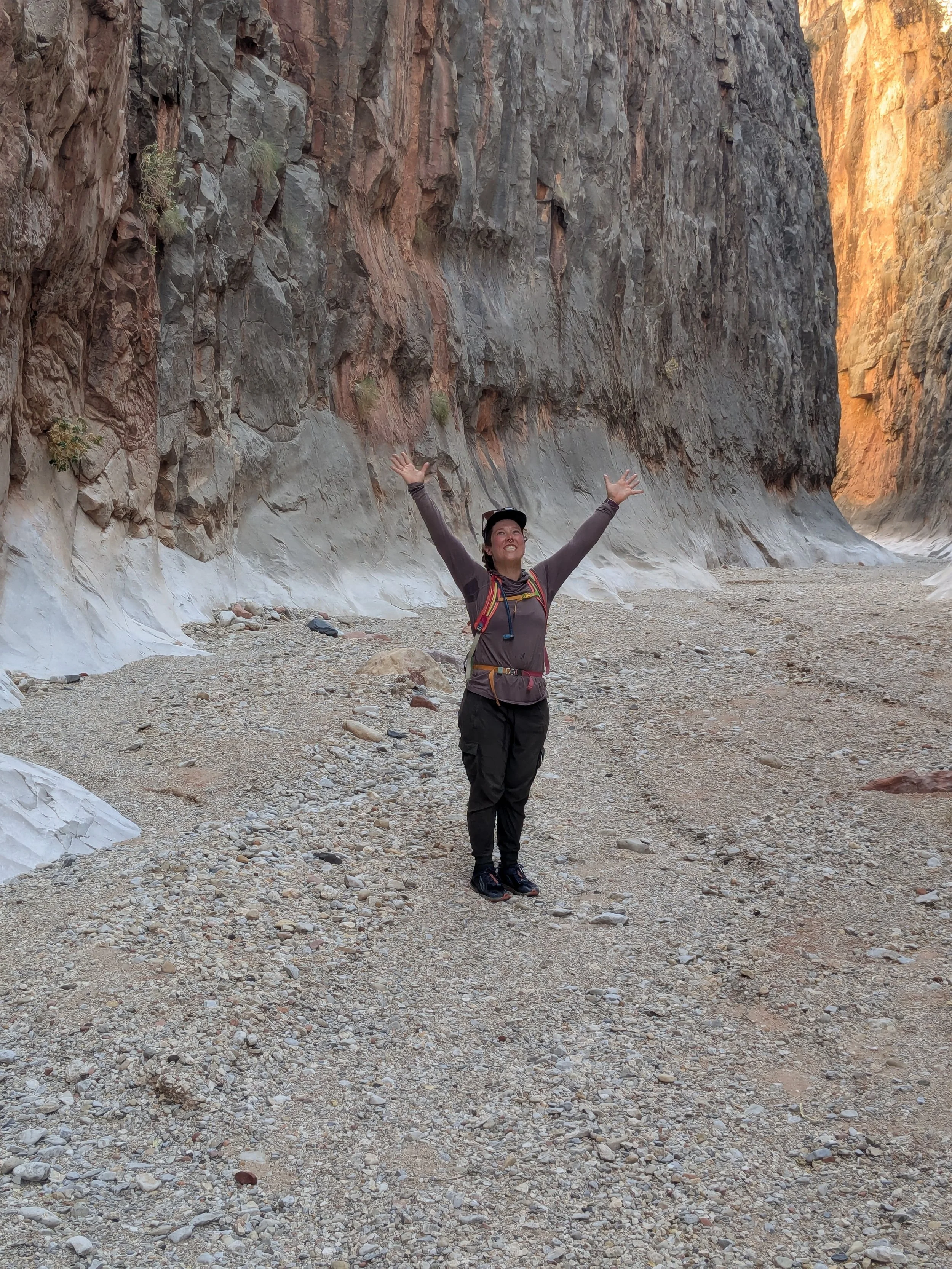
We continue to make progress through the Muav, crossing the small streams and pools that trickle from the limestone. Then on to the Redwall narrows—a strange place that almost looks like a subway tunnel, with a gravel bed underfoot and walls so high that they seem to curve back in above you, leaving only a narrow strip of blue.
It’s here that we encounter our first real test: our shade is running out.
We scamper along the sides of the canyon, darting from shade patch to shade patch, but there’s a reality that we can’t deny; as we’ve ascended, the canyon has started to widen, its sandstone and limestone palisades receding into the earth, providing less and less shade as the sun continues to climb. We start to drink our water faster; Sam breaks out the wet shirt that he’s stashed in a Ziploc bag. I pull up my hood, retreat behind my visor and sunglasses. Tyler puts on his sunglasses, and concedes to my offer of sunscreen. Dena alone seems unfazed, and continues to chat idly and wonder at the scenery unfolding around us.
We start seeing the first evidence of the Supai group, the rock layer we’re looking for; we continue to skirt the margins of the drainage, trying to stay in the shade as long as possible. But despite the canyon starting to open, the going hasn’t gotten any easier. We’re forced to spend longer and longer stretches in the sun as we navigate huge rockfalls and bouldering problems, the rock growing hot to the touch. I try not to think about how much lighter my pack has become, how little water I have left—the last water we saw was back in the Muav, some miles behind us. All the while, we’re craning our necks up and around us, looking for some evidence of a flat panel, anything that some long-ago artist would have found a worthy canvas for their vision. We stop every so often, questioning whether we missed it—and decide to keep going, spurred on by the idea that what if it’s just around the corner?
Finally, the drainage flattens out; the Supai cliffs, once towering hundreds of feet over us, have in turn begun to shrink, giving way to an open, ancient delta.
The heat has become oppressive, and I can feel that particular sear on my skin, even under my shirt, that tells me it is well over 100 degrees. The large, flat panels of sandstone are gone, replaced by smaller cliffs and alcoves; it seems unlikely that it would be just around the corner. Hell, there don’t even seem to be any corners left.
So there we were—tucked into that scrap of an alcove, red-faced with heat, nearly out of water. Dusty, uncertain, each hoping someone else would have some insight, some inkling as to whether to keep going or turn back.
After a few minutes of agonized internal debate, I pull the plug.
We keep an eye out on the cliffs above us as we retreat back into the Supai—maybe this whole quest would not be in vain?—but now we have a more pressing problem: we have to make it 8 miles back through the desert, in the July heat, without getting heat stroke.
By the time we made it back to the Muav, we were all well and truly out of water. The shade was starting to creep back to the canyon, but it did little to dispel the heat.
At last, we found water—a green, mucky pothole of it.
I eyed it skeptically. We had a water filter for this exact reason—but still, ugh, gross.
In the end though, none of us could say with certainty when the next source of water was. So we chose tomorrow’s potential giardia over today’s certain dehydration. We all tried to take measured sips—filtering the mucky water was slow going—but we each downed a liter before we could help ourselves. We topped off with another half-liter each, and kept going. By the time we reached the next pool—clearer than the last, but still with plenty of algae—we were out of water again, and had no choice but to stop and filter. Desperate to cool ourselves off, we dunked in the shallow pool before we left; it was still hot enough to dry us in about 20 minutes.
By now, we were running into a new problem. Dusk falls with peculiar speed in the Grand Canyon, even at the height of summer. With water filtration taking so long, the canyon had fallen back into shadow. We had headlamps, but still three boss battles—chockstones—to get past. The slipperiest, most technical ones of course. Our gait took on a new urgency, trying to use the last scraps of light but not twist an ankle in haste.
In the end, haggard and exhausted, we stumbled back into camp just as darkness was truly settling. Our team cheered us on and immediately offered electrolytes and—mirabile visu—hamburgers. Having had nothing but jerky, dried mango, and various granola bars all day, we fell to the burgers with a dazed intensity, still a little in disbelief that we had made it. I was still on the fence about the whole thing, still trying to make sense of it—had we failed? What is a “successful” adventure, anyway?Whatever, pictographs are overrated. Good thing none of us got heat stroke.
